**Semaphore review
Semaphore : s >= 0인 글로벌 정수 synchronization 변수, P와 V operation에 의해 조절
P(s) :
- s != 0 -> s를 1 감소, 즉시 리턴
- s == 0 -> s가 0이 아닐 때까지 스레드가 suspend => V operation에 의해 스레드가 wakeup
- 스레드가 wakeup 후, P가 s를 감소시키고 caller에게 제어권을 넘겨줌
V(s) :
- s를 1 증가
- P에서 s가 0이 아닐 때까지 기다리면서 block된 스레드가 있으면, 이 스레드 중 하나를 wakeup시켜주고, s를 감소시키면서 P를 완료
semaphore s는 무조건 0 이상
mutual exclusion을 통해 공유된 리소스를 보호하기 위해 semaphore를 사용하는 경우
- basic idea : 1로 초기화된 semaphore인 mutex를 각 공유된 변수 ( 또는 공유된 변수와 관련된 집합)과 결합
: P(mutex)와 V(mutex)가 있는 공유된 변수(s)로 각 access를 둘러쌈
mutex = 1
//mutex lock을 걸어줌
P(mutex)
cnt++
V(mutex)
1. Semaphore을 사용하여 공유된 리소스 (data structures)에 대한 access를 조정
- basic idea : 스레드는 semaphore을 사용하여 몇몇 조건이 true가 되었음을 다른 스레드에게 알림
- counting semaphore을 사용하여 리소스의 state를 유지하고 다른 스레드에게 알림
- mutex를 사용하여 리소스에 대한 접근을 보호
- examples : The producer-consumer problem, The Readers-Writes Problem
2. Producer-Consumer problem
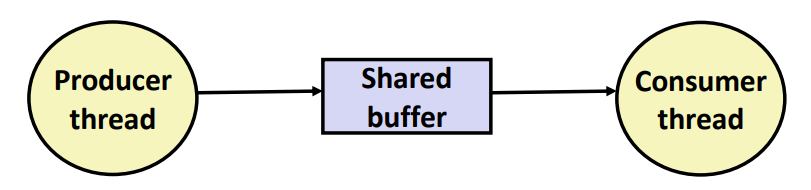
producer thread : 생산, 버퍼를 채움, 만약 버퍼가 가득 차면 더이상 생산을 하지 않고 중단
consumer thread : 소비, 버퍼가 empty이면 consume 할 게 없으므로 중단
(1) Producer는 slot이 빌 때까지 wait, 버퍼에 item을 넣어주고 consumer에게 알림
(2) Consumer는 item을 기다리고, 버퍼로 부터 item을 remove, producer에게 알림
(3) ex
- 멀티미디어 processing : 프로듀서는 MPEG 비디오 프레임을 생산하고 consumer에게 제공
- 이벤트를 기반으로 한 graphical user interfaces : 프로듀서는 마우스의 클릭, 이동, 키보드 힛을 감지하고 버퍼에서 일치하는 이벤트에 넣음
: consumer는 버퍼로 부터 이벤트를 찾고, 디스플레이에 paint
(4) Producer-Consumer on an n-element Buffer
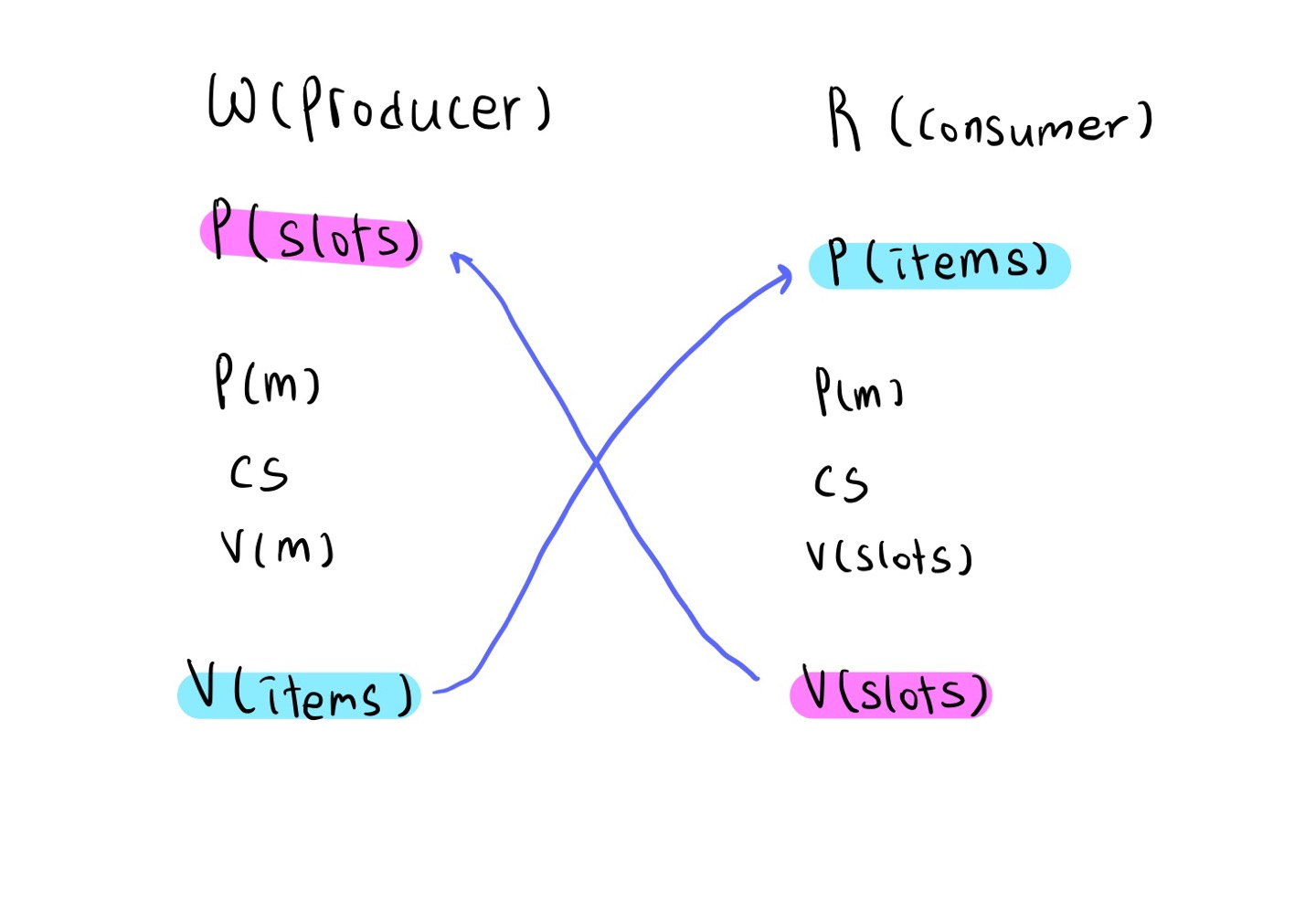
- mutex와 2개의 counting semaphore 필요
: mutex - 버퍼에 대한 접근을 mutually exclusive하게 강요
: slots - 버퍼의 가능한 slot을 셈, 즉 버퍼에서 남아있는 자리를 count, Producer의 입장에서 몇 개를 insert 할 수 있는지
: items - 버퍼에서 가능한 item을 셈, 버퍼에 몇 개의 item이 들어와 있는지, Consumer 입장에서 몇 개를 소비할 수 있는 지
- shared buffer package(sbuf)를 통해 구현
Declarations
#include "csapp.h”

typedef struct {
    int *buf; /* Buffer array */
    int n; /* Maximum number of slots */
    int front; /* buf[(front+1)%n] is first item */
    int rear; /* buf[rear%n] is last item */

    //binary semaphore
    sem_t mutex; /* Protects accesses to buf */

    //counting semaphore
    sem_t slots; /* Counts available slots */
    sem_t items; /* Counts available items */
} sbuf_t;

void sbuf_init(sbuf_t *sp, int n);
void sbuf_deinit(sbuf_t *sp);
void sbuf_insert(sbuf_t *sp, int item);
int sbuf_remove(sbuf_t *sp);
공유된 버퍼를 intializing 및 deinitializing
/* Create an empty, bounded, shared FIFO buffer with n slots */
void sbuf_init(sbuf_t *sp, int n)
{
    sp->buf = Calloc(n, sizeof(int));
    sp->n = n; /* Buffer holds max of n items */
    sp->front = sp->rear = 0; /* Empty buffer iff front == rear */
    Sem_init(&sp->mutex, 0, 1); /* Binary semaphore for locking */
    Sem_init(&sp->slots, 0, n); /* Initially, buf has n empty slots */
    Sem_init(&sp->items, 0, 0); /* Initially, buf has 0 items */
}

/* Clean up buffer sp */
void sbuf_deinit(sbuf_t *sp)
{
	Free(sp->buf);
}
초기 버퍼는 빈 버퍼이므로 front와 rear는 맨 처음을 같이 가르키고 있음
mutex는 처음에 1로 초기화
slots는 비어있는 버퍼의 자리를 의미하므로 n으로 초기화
item은 버퍼에 들어가 있는 item을 의미하므로 0으로 초기화
구현
공유된 버퍼에 아이템 삽입
/* Insert item onto the rear of shared buffer sp */
void sbuf_insert(sbuf_t *sp, int item)
{
    P(&sp->slots); /* Wait for available slot */
    //slot = 0이면 wait, 0이 아니면 감소하고 다음 코드 실행

    //mutex lock을 걸어줌
    P(&sp->mutex); /* Lock the buffer */
    sp->buf[(++sp->rear)%(sp->n)] = item; /* Insert the item */
    V(&sp->mutex); /* Unlock the buffer */
    //

    //block된 스레드를 깨워줌, item 증가시킴
    V(&sp->items); /* Announce available item */
}
공유된 버퍼로 부터 아이템 제거
/* Remove and return the first item from buffer sp */
int sbuf_remove(sbuf_t *sp)
{
    int item;
    P(&sp->items); /* Wait for available item */
    //item이 0이면 suspend, 0이 아니면 decrement하고 다음 코드 실행

    //mutex lock
    P(&sp->mutex); /* Lock the buffer */
    item = sp->buf[(++sp->front)%(sp->n)]; /* Remove the item */
    V(&sp->mutex); /* Unlock the buffer */

    //slot을 증가하고 slot이 없어서 wait하고 있는 스레드가 있으면 wakeup하고 작업 수행
    V(&sp->slots); /* Announce available slot */
    return item;
}
(5) Readers-Writers Problem
- mutual exclusion problem의 일반화
- Problem statement
: Reader 스레드는 오직 object를 read만 함
: Writer 스레드는 object를 수정
: Writer는 반드시 object에 대해 exclusive access를 가짐
-> 내가 write를 하는 중이면 read x, write x -> 즉, 혼자만 write할 수 있음
: 무한한 reader는 object에 접근할 수 있어서 누구나 read할 수 있음
하지만 누군가가 read하고 있을 때 write는 wait
(6) Variants of Readers-Writers
- 문제1 : favors readrs ( reader에게 우선순위를 줌)
-> writer가 object를 사용하기 위해 허가된 permission을 가질 때까지 reader는 wait하지 않음
-> waiting writer 후에 도착한 reader는 writer보다 우선 순위를 가짐
즉 R->W->R일 때 W는 Wait하지만 W 뒤에 온 R은 object를 read할 수 있음
=> writer가 계속 wait하므로 starvation (스레드가 무한정으로 wait하는 상태) 발생
- 문제2 : favors writers ( writers에게 우선순위를 줌)
-> writer가 읽을 준비가 되면, 가능한 write을 빠르게 완료
-> writer가 wait하고 있는 중이라도 writer 후에 도착한 reader는 반드시 wait해야 함
=> reader가 계속 wait하므로 starvation 발생
- Solution to First Readers-Writers problem
//Readers
int readcnt; /* Initially = 0 */
sem_t mutex, w; /* Initially = 1 */
void reader(void)
{
    while (1) {
    P(&mutex);
    readcnt++;
    if (readcnt == 1) /* First in */
    	P(&w);
    V(&mutex);

    /* Critical section */
    /* Reading happens */

    P(&mutex);
    readcnt--;
    if (readcnt == 0) /* Last out */
    	V(&w);
    V(&mutex);
    }
}
//Writers
void writer(void)
{
while (1) {
P(&w);
/* Critical section */
/* Writing happens */
V(&w);
}
}
(7) Putting it all together: Pthreaded Concurrent Server

쓰레드를 미리 생성해서 안쓰는건 sleep, 필요하면 깨움
- Prethreaded Concurrent Server
sbuf_t sbuf; /* Shared buffer of connected descriptors */
int main(int argc, char **argv)
{
    int i, listenfd, connfd;
    socklen_t clientlen;
    struct sockaddr_storage clientaddr;
    pthread_t tid;

    listenfd = Open_listenfd(argv[1]);
    sbuf_init(&sbuf, SBUFSIZE);

    for (i = 0; i < NTHREADS; i++) /* Create worker threads */
    	Pthread_create(&tid, NULL, thread, NULL);

    while (1) {
        clientlen = sizeof(struct sockaddr_storage);
        connfd = Accept(listenfd, (SA *) &clientaddr, &clientlen);
        sbuf_insert(&sbuf, connfd); /* Insert connfd in buffer */
    }
}
worker thread routine
void *thread(void *vargp)
{
    Pthread_detach(pthread_self()); //쓰레드 종료시 쓰레드 자원 정리
    while (1) {
        int connfd = sbuf_remove(&sbuf); /* Remove connfd from buf */ //connfd를 버퍼에서 꺼냄
        echo_cnt(connfd); /* Service client */
        Close(connfd);
    }
}
echo_cnt initialization routine
static int byte_cnt; /* Byte counter */
static sem_t mutex; /* and the mutex that protects it */

static void init_echo_cnt(void)
{
    Sem_init(&mutex, 0, 1);
    byte_cnt = 0;
}
worker thread service routine
void echo_cnt(int connfd)
{
    int n;
    char buf[MAXLINE];
    rio_t rio;
    static pthread_once_t once = PTHREAD_ONCE_INIT;

    Pthread_once(&once, init_echo_cnt); //쓰레드 초기화를 한 번만
    Rio_readinitb(&rio, connfd);
    while((n = Rio_readlineb(&rio, buf, MAXLINE)) != 0) {
        P(&mutex);
        byte_cnt += n; //mutex lock으로 잡아둠
        printf("thread %d received %d (%d total) bytes on fd %d\n",(int) pthread_self(), n, byte_cnt, connfd);
        V(&mutex);
        Rio_writen(connfd, buf, n);
    }
}
'SP' 카테고리의 다른 글
| [sp] Thread-Level Parallelism (0) | 2022.05.17 |
|---|---|
| [sp] Synchronization: Advanced (2) (0) | 2022.05.17 |
| [sp] Synchronization: Basics (0) | 2022.05.03 |
| [sp] Concurrent Programming (2) (0) | 2022.04.15 |
| [sp] Concurrent Programming(1) (0) | 2022.04.11 |


